Executive Function Coaching vs. Tutoring: What's the Difference?
A tutor helps your child understand the material. An executive function coach helps with the skills around the material: getting started, staying organized, managing time, and following through. If your child knows what to do but can't seem to do it, that's usually an executive function issue, not a content issue.
Prefer to listen to this article? I recorded myself reading this post out loud, so feel free to press play and listen instead. (A lot of us take things in better by ear, and that's a good thing to know about your own brain!)
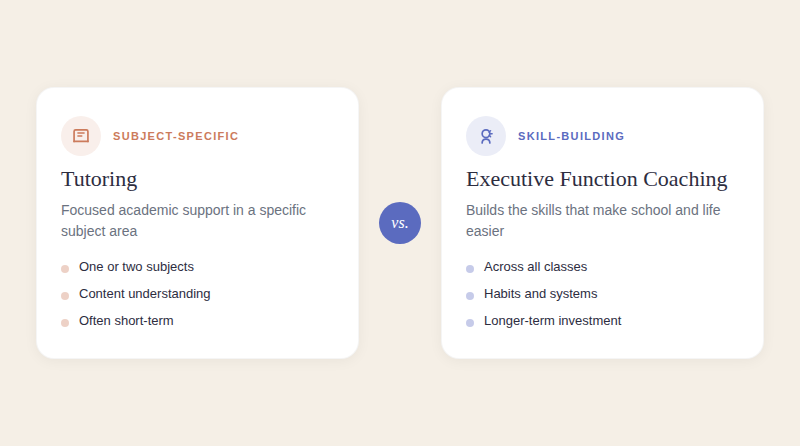
If your child is struggling in school, your first instinct might be to find a tutor. Tutoring is a wonderful resource and has helped countless students improve their grades and feel more confident in the classroom. I know many families, including mine, who have benefitted from tutoring sessions. But if you've already tried tutoring and aren't seeing the results you hoped for, or if your child's struggles seem to go beyond just one subject, it might be worth asking a different question: is this an academic problem, or is this an executive function problem? The answer can help steer you towards the support that will be the most helpful and effective for your child. In this blog post, I’ll look at how tutoring and executive function coaching support students and help you figure out which one would be most helpful.
What tutoring is and when it's the right call
Tutoring is subject-specific academic support. A good tutor has deep knowledge in their specialty area, such as math, science, writing, a foreign language, and can break down concepts, fill in gaps, and teach study skills specific to that subject. Tutoring tends to be relatively focused in scope and duration. Some students work with a tutor for a semester, others for a school year, and students may decide they don't need it long-term once they feel more confident and caught up. I know of a student who meets with her calculus tutor before every exam to review concepts she’s not feeling confident about, but doesn’t feel she needs support beyond that level. Another student I know meets weekly with her math tutor, who provides her support throughout the school year.
Let’s look at when tutoring might be the right fit. This is not an inclusive list and there may be other situations that may be helped by tutoring, but it’s a good place to start.
Your child's challenges are specific to one or two subjects, not across the board
They're keeping up with their work but not performing as well as they'd like on tests or homework
They're saying things like "I just don't get it" or "my teacher explains it in a way that doesn't make sense to me"
A teacher has recommended extra help in a particular area
They’re experiencing some test anxiety, but only in a specific subject or two
They're running out of time on tests, which can indicate more global struggles, but it can also suggest they need more practice with the content itself or need to learn additional approaches to understanding the material
To find a tutor, you or your child can ask their teacher or school counselor for recommendations. Local Facebook groups are a good place to check, as well. For free options, some high schools have peer tutoring centers and public libraries may offer tutoring. There are online websites that offer directories of virtual and in-person tutors, or you can connect with larger tutoring companies. Simply search online for the subject and the word “tutoring”. If you are interested in local options or want to support small businesses, scroll down past the sponsored listings at the top of the results page and you’ll find local or small business options. There are no official credentials for tutors, so you’ll want to make sure any potential tutors have a degree or at least extensive coursework or experience in the area your child needs tutoring. Some tutors work exclusively online, some exclusively in-person, and many will do a combination. The best arrangement is the one that works for your child and your lifestyle, so be sure to have a conversation with your child first.
Before we move on to executive function coaching, it's important to note that many, or even most, tutors naturally incorporate some organizational and study support into their work. This helps improve the students’ ability to learn more and do better on tests. However, that often isn't a tutor’s primary focus or goal, which makes sense, and for some students, their challenges run deeper than hard work in one subject can address.
What executive function coaching is and when it might be a better fit
Instead of teaching specific skills in algebra or chemistry, executive function coaches help your child build the underlying executive function skills that give them confidence and make school and life easier. These skills support things like planning ahead, getting started on tasks, staying organized, managing their time, and following through on tough assignments. While these skills don’t directly impact their understanding of the quadratic equation, they do help them persevere through the challenge of learning it, remember to do their math homework on time and turn it in, and make a solid plan for studying for their exams.
While tutoring may only be needed for a relatively short period of time, executive function coaches work on changing behavior. Unhelpful habits and behaviors are pesky buggers and tend to hang around. Building new habits, for children and adults, needs a lot of support. This is why executive function improvement takes time and frustratingly, there is not a quick fix. This is also why, regardless of age, executive function coaching tends to be a longer-term investment than tutoring. But when these essential skills are the root of the struggle, strengthening them can make everything else easier, including the specific subjects your child is working with a tutor on.
Executive function coaching might be worth exploring when:
Your child's struggles are global, meaning they show up across most or all of their classes, especially the ones they find boring or difficult
They have a hard time keeping up with the work itself, not just understanding the content
Disorganization is a recurring theme, featuring lost assignments, missed deadlines, a backpack that's a black hole
You're noticing school or homework avoidance, low confidence, or a lot of stress and frustration around school in general
The same patterns show up at home and at school, and maybe in extracurriculars too
Teachers and parents are noticing the same behaviors at school and at home
Your child has ADHD, anxiety, or another learning difference, as these are very commonly associated with executive function challenges
Finding the right executive function coach
Finding the right executive function coach may require a little more effort than finding a tutor. First, the right fit between coach and client really matters because, as all coaches will tell you, the most critical key to success is whether or not your child trusts the coach. The rapport between the coach and client is just as important as the strategies the coach teaches your child. If your child does not feel that they can be open and honest with their coach, it will be very difficult for the coach to help create lasting change and develop helpful habits. When interviewing a potential coach, you can feel comfortable asking them what their coaching style is, sharing about your child’s personality and what works for them, and sharing how involved you as the parent want to be in the coaching relationship. I also think it’s worth it to pay attention to your and your child’s gut feeling when choosing a coach. If your gut tells you that they may not be a good fit, listen to it and look elsewhere.
Just like tutors, there are no requirements for credentialing or education for executive function coaches. Many coaches, including me, have a Master’s degree or higher and extensive training and education in executive function coaching, but do not hold any coaching credentials. My training is through the highly-regarded coaching company, Beyond BookSmart, for which I have coached since 2017. If this matters to you, you’ll want to look for a coach who has been through a credentialed training program. If official credentials don't matter to you, you'll want to make sure they can speak knowledgeably about executive function skills and how they show up for students your child's age, have experience working with students in your child's age group, and can share some information about their coaching approach and what a typical session looks like. Testimonials or references from other families are also good to ask for. You can also ask whether they have experience with your child's specific challenges (ADHD, OCD, anxiety, etc.) and whether they offer any kind of introductory call so you and your child can get a feel for them before committing.
When you begin your search for a coach, you’ll have to decide if you want a coach who works virtually, in-person, or both. I offer both virtual and in-person coaching, which allows me to support clients all over the country (or internationally!). For my local clients, I often do a combination of in-person and virtual sessions, depending on what we plan to work on that week. Some students need the in-person connection, others may be more comfortable with a little distance, and some may prefer virtual due to scheduling or other needs. A Google search for “executive function coaching” will bring up sponsored links at the top for larger organizations, most of whom offer virtual coaching. Scroll down a bit and you’ll find smaller coaching organizations and local coaches, especially if you add, “near me” to your search query. If you’re not coming up with anything in your area, you might also try, “adhd coaches”, as many ADHD coaches naturally do executive function coaching. If your child does not have ADHD, you’ll want to ask the potential coach about their experience coaching people without ADHD.
What does an executive function coaching session look like?
Usually, sessions begin with a few minutes of chatting, perhaps on topics not related to academics at all. From the outside, this may look unproductive, but it’s actually the most important part of a session. While chatting, the coach is re-establishing rapport, gauging the student’s energy levels and mindset, determining the approaches they may use during the session, and giving the student a chance to take a breath and share what’s on their mind. This chatting time helps the student settle in, get ready, and regulate themselves, if needed. What’s accomplished in each session will likely vary because our executive function capacity changes as the demands placed on us change. One week, your child might be feeling really on top of things, so their coach can take the time to teach them a new strategy or do a deep dive on their current system to see what’s working or not. Another week, your child may have an exam the next day, so their coach might help them practice some strategies to relieve test anxiety, determine what material still needs to be reviewed, or do some last-minute quizzing of the material. And in another week, your child might be coming up on an extremely busy time of the school year, so they and their coach can do some planning, prioritizing, and organizing of materials to make it easier to get through the challenge of the next couple weeks. Good coaches are extremely flexible and creative, and are ready to help their clients tackle whatever challenges come their way.
Can a student work with both a tutor and an executive function coach?
Absolutely! Many of my clients who are students have worked with tutors while in coaching. In many cases, it's the most effective approach. I like to think of it this way: if a student is struggling to understand the content in their math class AND struggling to sit down and do their homework every night, a tutor can address the math and relieve some of the struggle there, while their coach helps build the habits that make studying effective and actually happen. The two supports complement each other really well. In fact, some families find that once their child starts making progress with their executive function skills, they need less tutoring support over time, because they're now able to manage their learning more independently.
Do executive function unicorns exist? You may find a great executive function coach who also specializes in the subject area your child needs help with, but this is not always the case. I wouldn’t let it stop you from hiring the executive function coach, especially if you feel they are a great fit for your child otherwise. The skills that support the learning of the difficult content are just as critical to success, and an executive function coach can help regardless of their knowledge of that subject. For example, I can support clients directly with their writing assignments, but math and I are not friends beyond some (very) basic algebra. In both situations, I’m able to help students feel more confident in their schoolwork.
Not sure which one your child needs?
That's completely okay. It's not always obvious, and sometimes it takes a conversation to figure it out. If we look through an executive function lens at what your child is saying, doing, and experiencing, we can figure out what might be going on. If you're wondering whether executive function coaching might be a good fit for your child, I'd love to chat. And if you'd like to learn more about what executive function skills are and how they show up in daily life, check out my post “What Are Executive Function Skills?” for a deeper dive.
Want to explore this further?
Learn more about executive function coaching
If you're curious about how strengthening executive function skills can improve your daily life, learn more about executive function coaching or book a free intro call with me. We can talk about what's going on and whether I can help.
Try the free planning tool
Not ready to talk yet? Download the free weekly planning tool and see what executive function strategies look like in practice.
Or just want more articles like this? Subscribe to the newsletter for occasional executive function tips and strategies.