Top Ten Tips for Engaging Your Audience from an Executive Function Coach
Keeping an audience engaged isn't just about being a dynamic speaker. It's about designing your presentation around how the brain naturally pays attention and learns.

When we design and present for an audience through an executive function lens, we increase their ability to engage and learn. This makes a better experience for them, but also for you, the presenter. Even if you despise public speaking, I’d be willing to bet that you’ll have a better time and get better results if you design and present with executive function skills in mind.
In early 2026, I contributed an opinion piece on this topic to AhaSlides’ white paper entitled, The Science of Distraction: A Research-Backed Guide to Attention at Work and Designing Presentations People Actually Stay With. I wanted to expand on this concept in a blog post, so here are my ten tips for engaging your audience from an executive function coach who loves public speaking and designing workshops and presentations with executive function skills in mind.
1. Set clear expectations before and at the start
Tell people what to expect before they even arrive, through your event description, email, or syllabus, and again at the start of the session. When people know what's coming, their brains can relax and focus on learning rather than trying to figure out what's happening next. An effective presentation starts before you even walk into the room or start the Zoom session.
Executive function connections: Working Memory, Sustained Attention, Emotional Regulation
2. Start with emotion, not information
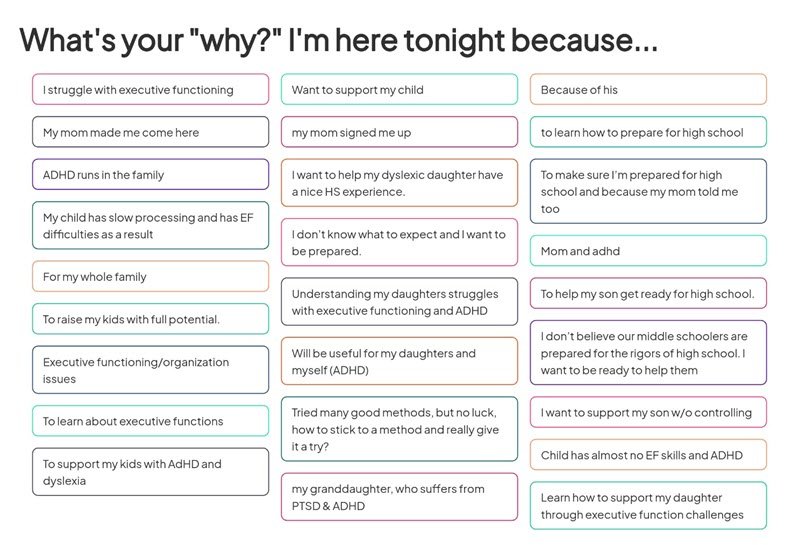
Lead with a story, a relatable moment, or a surprising question rather than a statistic or agenda slide. Emotional engagement and relevancy makes content stick in people’s memory. If you’re comfortable with it, sharing a brief story about yourself that’s relevant to the topic is an engaging way to start. After my initial greetings and some brief housekeeping, I like to start with an interactive slide that asks, “What is your ‘why?’ I’m here tonight because…” Not only does it get people to engage right from the beginning, but it also helps them see that others are feeling similarly - frustrated, curious, ready to learn. Whatever their emotional state is, they’re clearly not alone. To make it more relevant, I can often tie their answers back to why I’m passionate about the topic myself.
Executive function connections: Working Memory, Sustained Attention, Emotional Regulation
3. Keep your message simple and focused
Identify and limit your key messages before you begin creating your slide deck and presentation notes. It’s hard, but resist the urge to cover everything. Overloading people's prefrontal cortex creates, as my executive function coaching client, Josh, always says, a “log jam” where nothing gets through. This can be especially true if people are going into the training or workshop feeling anxious or nervous. Their executive function capacity may already be at its max, so trying to shove a bunch of knowledge in there isn’t going to be successful no matter how engaging you are. Making sure that everything you share ties directly back to the one thing you really want them to leave with is a good way to help yourself limit your content. It may mean you have to cut content, but it truly levels up the quality of your work and increases the chance that your audience will walk away actually remembering what you taught them.
Executive function connections: Working Memory, Planning & Prioritization
4. Build in attention resets every ten minutes
In his book Brain Rules, John Medina talks about the importance of doing something emotionally relevant every ten minutes to help the brain stay engaged. Tie your content back to your audience, change the activity to involve the audience, share your story, or make your slides feel personal to regularly bring people back into the room. In addition to making it emotionally relevant, you can also change up the format throughout the presentation. This could be a question posed to your audience that gets them thinking, a short video, a story, a poll, or even a moment to make everyone laugh. I like to follow content-heavy sections with a question to the audience or an interactive activity that connects the content with their lives. It re-engages people’s brains, asks them to apply the information they’ve just been given, and also gives me a chance to take a breath.
Executive function connections: Sustained Attention, Task Initiation, Emotional Regulation
5. Make it interactive and participatory
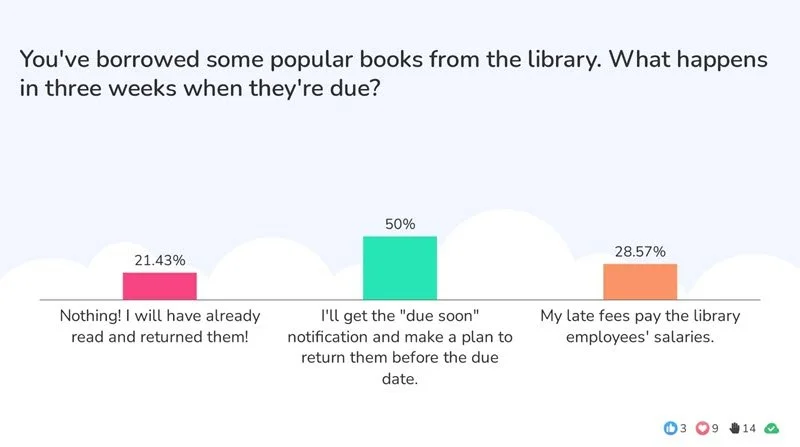
When people actively contribute to the presentation or workshop, they're more likely to remember and stay engaged. Polls, word clouds, discussions, and quizzes all shift people from passive recipients to active learners. You may even want to explore how you can co-create solutions or content with your audience throughout the presentation. I really love using AhaSlides’ interactive activities, but even if you don’t use software like that, you can include interaction opportunities through asking questions, prompting small group discussions, or having people vote by raising their hand or using their thumb to indicate their opinion about something. For virtual presentations, you can take advantage of polls and the chat feature in most presentation platforms, such as Zoom, Teams, and Google Meet. I encourage you to get creative. Your audience will appreciate it and you’ll have a better time yourself!
Executive function connections: Working Memory, Sustained Attention, Impulse Control and Self-Monitoring
6. Use uncertainty and surprise strategically
Keep people slightly on their toes with unexpected examples, counterintuitive ideas, or moments they didn't see coming. The brain pays more attention when it's a little bit surprised. We don’t want to make them uncomfortable, so some of this does require reading the room. I especially like using reverse brainstorming to help people think creatively. We may do some brainstorming and instead of coming up with a perfect solution to a problem, we first think of how we can make it worse. This kind of thinking is definitely not what we do every day, so incorporating this into a workshop or class might be just the thing to keep people engaged and thinking creatively!
Executive function connections: Sustained Attention, Flexible Thinking
7. Regulate yourself first
Due to mirror neurons in the brain that mimic the behaviors of others around us, our emotions are contagious! It’s a phenomenon called emotional contagion. A calm, prepared, and present presenter or facilitator helps the audience feel settled and open to learning. An anxious or disorganized presenter likely does the opposite. Your behavior, your presence, and how prepared you appear will play a huge part in how engaged your audience is. Even if you feel ready to go, take the time to regulate yourself before you arrive at the event or go live for a virtual event. This might mean having a snack or some water, taking some deep, calming breaths if you’re feeling overly anxious, or running in place or doing some jumping jacks if you’re tired. And, way before the day of the event, be sure that you’re well-prepared. You’ve gotta know your stuff! A good test is to see if you can do your presentation without speaker notes. Your level of preparedness will show and your audience will pick up on it, whether you want them to or not.
Executive function connections: Emotional Regulation, Metacognition, Impulse Control and Self-Monitoring
8. Design your materials and environment for every brain
Clean slides, clear structure, fidget tools, movement breaks, and explicit signposting about what's coming all reduce cognitive load and support focus for everyone, neurodivergent or not. In order to maintain your audience’s attention, it’s helpful to understand a little bit of the research on how the brain pays (or struggles to pay) attention. Visually attractive slides that are clean and not overly wordy encourage the brain to pay attention using automatic attention. To further increase learning, our brains need to engage in voluntary attention which requires effort and can lead to mental overload when the environment or task demands a lot of attentional resources. This is why when we’re designing and delivering presentations, it’s critical to consider our audience’s capacity for attention. Finding the balance between interesting enough to get their attention and streamlined and clear to help them stay engaged is tricky, but a worthwhile endeavor. Attention and working memory are deeply connected. As Dr. Sherrie All said when I interviewed her on the Focus Forward podcast, “We can't remember what we don't pay attention to.”
Executive function connections: Sustained Attention, Working Memory, Emotional Regulation, Organization
9. Minimize switching and distraction
Set clear expectations about phones and notifications at the start of your session or presentation. AhaSlides conducted a survey of over 1,000 presenters and found that 82% of presenters reported regular audience distraction and cited multitasking, digital device use, screen fatigue, and lack of interactivity as major reasons for audience distraction. It may seem counterintuitive that AhaSlides and other interactive slide deck software do require the use of another device or browser window, but there’s a difference between using their phones as an engagement and interactivity tool and mindless scrolling, which people might do if they’re bored during your presentation.
Executive function connections: Sustained Attention, Impulse Control and Self-Monitoring, Working Memory
10. Build in reflection time
Give people a moment to process what they've learned, write something down, share with a partner, or set a goal before they leave. This is another opportunity for people to engage with materials and apply it to their own life. It increases relevance and asks them to think about everything you’ve just shared with them. You could ask, “What did you learn today that you’ll use in your own life and how will you modify it to fit your needs?” I like to use an AhaSlides Open Ended slide so people can share anonymously. Or if you're not using interactive software, you can ask people to drop their takeaways in the chat. Reflection time can also increase interactions between audience members, whether it’s live or in the chat, which boosts engagement right up till the end!
Executive function connections: Metacognition, Goal-Directed Persistence, Working Memory
Start small and notice what shifts
I think I’m preaching to the choir when I say that designing and delivering a presentation that truly engages your audience is challenging! And, it’s especially hard in a world that is constantly competing for their attention. I hope that this post shows how by understanding the brain a little bit, and specifically how executive function skills support learning and engagement, we can make choices that give our message a chance to get through to your audience. I shared these tips to help you work with your audience's brain rather than against it. Neurodivergent or not, as an executive function coach, I know that working with our brains leads to more success in life!
Whether you're a teacher, a trainer, a team lead, or a keynote speaker, I hope this gives you some practical and research-backed ideas to bring into your next session. As with anything new, start small and pick just one or two tips that resonate with you to try out. See if you notice any difference in your audience’s engagement. Doing this gives you a chance to practice your flexible thinking and metacognition, and your audience will benefit, too!
Want to learn more about executive function skills and how they show up in learning and daily life? Then head over to my post “What Are Executive Function Skills?” for a deeper dive. And if you're looking for someone to bring an engaging, brain-friendly workshop or talk to your school, team, or organization, I'd love to hear about it. You can learn more about my speaking and workshops here.
Or if you're curious about how executive function coaching could support you, your team, or your student, feel free to reach out to me and let's figure out what would be most helpful for you.
Note: I’m not being compensated by AhaSlides for this post, though I do earn a referral bonus if you sign up for a paid account through my referral link.